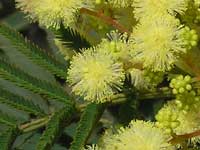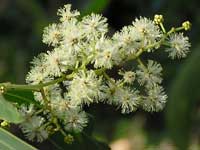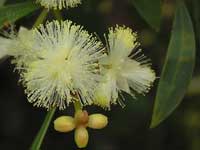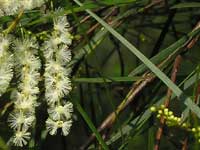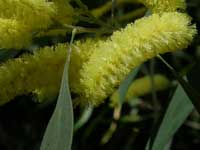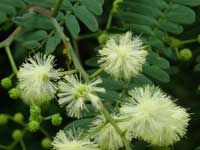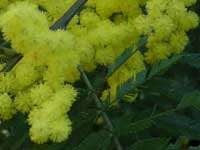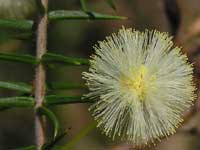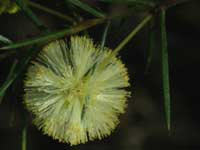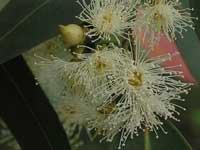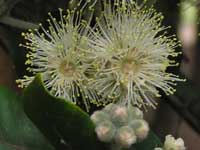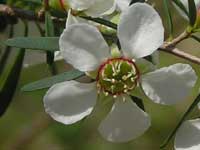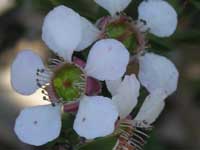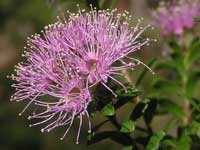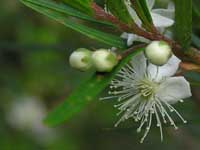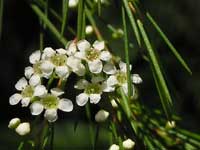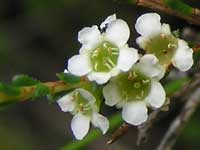
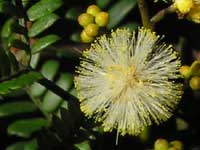
Sydney Green Wattle p8260070 image 162KB
Acacias & Myrtles
of the
Lane Cove National Park
Waratah Software logo 12sep08 home - contact us - about this

To return to
Lane Cove National Park Wildflowers
index

Acacias (wattles) - family Mimosaceae

There are an estimated 900 species of Acacia in Australia. And this includes the Australian Floral Emblem, the Golden Wattle (Acacia pycnantha) - which is not endemic to the Sydney region.

An index to the Acacia images included below.
Coast Myall
Flax-leaved Wattle
Heath Wattle
Hedgehog Wattle
Long-leaf Wattle
Myrtle Wattle
Parramatta Green Wattle
Prickly Moses
Rough-leaved Wattle
Sickle Wattle
Silver-stemmed Wattle
Spike Wattle
Sunshine Wattle
Sweet-scented Wattle
Sydney Golden Wattle
Sydney Green Wattle
White Sallow Wattle

Myrtles - family Myrtaceae

There are over 1,500 species in the mighty Myrtaceae family in Australia. These include Angophoras, Eucalyptus, tea-trees, bottlebrushes and paperbarks.

Members of the family include the tallest flowering tree in the world - the Mountain Ash. Plus cloves, guava, and allspice.

An index to the Myrtle images included below.
Burgan
Clustered Darwinia
Common Fringe Myrtle
Crimson Bottlebrush
Darwinia biflora
Deane's Tea-tree
Dwarf Apple
Fringed Baeckea
Narrow-leaf Myrtle
Narrow-leaved Bottlebrush
Paperbark Tea-tree
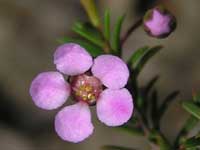
Pink Buttons
Pink Tea-tree
Prickly Tea-tree
Rosy Baeckea
Scribbly Gum
Sydney Red Gum
Tick Bush
Turpentine
Water Gum
Weeping Baeckea
White Mahogany
Woolly Tea-tree

Other attractions of the Lane Cove National Park

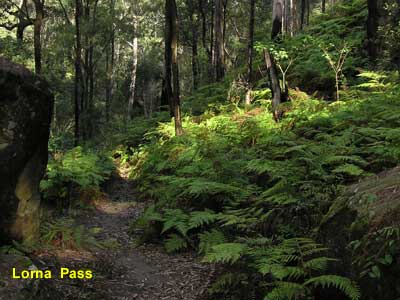
Lorna Pass Walking Track image 198KB

The Lorna Pass Walking Track is in the far north-western corner of the park.

It was named after Lorna Brand who organised the labour for its construction during The Great Depression - when nearly a third of Sydney's work force was unemployed.

Starting from Thornleigh Oval, a loop can be walked that includes Lorna Pass. Signage is not good at present, so best to walk in an anti-clock wise direction taking the left path each time.

Take your time to absorb its tranquillity and beauty.

The National Parks and Wildlife website provides details of walking tracks and facilities.
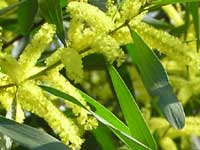

Acacias (wattles) - family Mimosaceae

Select the thumbnail image to see the full image.

Sydney Golden Wattle image P8120100 200KB
Sydney Golden Wattle
Acacia longifolia
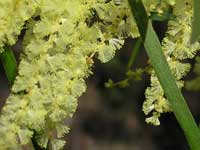
A single image can not do the Sydney Golden Wattle justice. Being over 4 metres tall, it is a small tree and colours the Sydney bush from late winter well into spring.
White Sallow Wattle image p8190162 166KB
White Sallow Wattle
Acacia floribunda
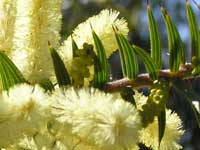
Similar to the Sydney Golden Wattle, but its pale yellow to white flowers and narrower leaves give it away. Also known as the White Sally Wattle it flowers in late winter.
Spike Wattle image p8190120 142KB
Spike Wattle
Acacia oxycedrus
A small tree, with very sharp broad leaves. Stunning when in flower in early spring.
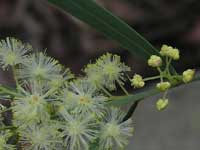
Parramatta Green Wattle image pc200189 127KB
Parramatta Green Wattle
Acacia parramattensis
Distinguished from similar wattles, by its green bark, the gland at the junction of the branchlets, and 3-4mm long leaflets.
It flowers in summer and is also known as the Parramatta Wattle.
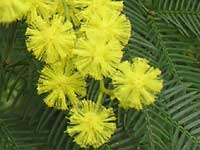
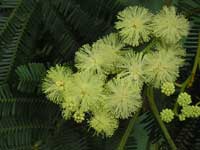
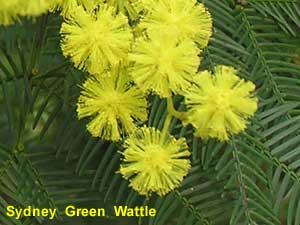
Sydney Green Wattle image p8260070 162KB
Sydney Green Wattle
Acacia decurrens
A beautiful tree. Characterised by its green branches and 10mm long "leaflets".
Sweet-scented Wattle image p8F106 83KB
Sweet-scented Wattle
Acacia suaveolens
Flowering in late winter, it does indeed have a gentle sweet smell.
Sunshine Wattle image p4020331 94KB
Sunshine Wattle
Acacia terminalis
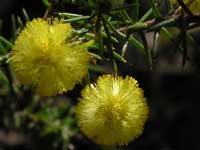
Its flowers are about 12mm in diameter and although mainly flowering in winter, it starts flowering in early autumn and continues to late spring. It is a small tree up to 2 metres in height.
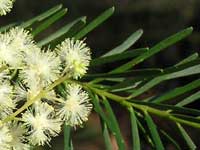
Flax-leaved Wattle image p4020353 139KB
Flax-leaved Wattle
Acacia linifolia
Identified by its narrow leaves and small flowers - which appear in summer and early autumn. This leggy tree has less flowers per flower-head which prevents it from having the yellow spheres of the Sunshine and Silver-stemmed Wattles.
Silver-stemmed Wattle image p8F106 146KB
Silver-stemmed Wattle
Acacia parvipinnula
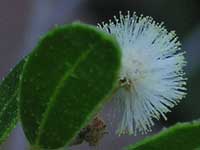
Flowering in spring, this wattle is identified by its silver-stems and numerous glands.
[I am a bit unsure of my identification, as although the plant was found well into the Park, there is only a single species and the area has been greatly disturbed over the years.]
Rough-leaved Wattle image p4120437 76KB
Rough-leaved Wattle
Acacia hispidula
Identified by its rough ovate leaves. Its flowers are about 10mm in diameter. It is a small tree up to 2 metres in height.
Sickle Wattle image p5060222 100KB
Sickle Wattle
Acacia falcata
Identified by its curved sickle-shaped leaves - the main vein of which is offset towards the top. It flowers in winter.
Myrtle Wattle image p7290086 96KB
Myrtle Wattle
Acacia myrtifolia
Flowering in late winter, it is identified by its red (middle age) branches, and the gland on the inside edge of its leaves. It is also known as the Red-stemmed Wattle.
Long-leaf Wattle image pc150341 156KB
Long-leaf Wattle
Acacia longissima
This small summer flowering tree is also known as the Narrow-leaved Wattle. It can be identified by its narrow and long leaves (typically 2-3mm wide and 15cm long) with a prominent central vein. The flower spikes are 3-4 cm in length.
Coast Myall image p9090379 156KB
Coast Myall
Acacia binervia
Its beautiful silvery-grey curved leaves that have three veins, identifies it.
Its stringy-bark like trunk also helps.
It flowers in late winter/early spring.
Three prickly customers ...
Prickly Moses image p4020253 80KB
Prickly Moses
Acacia ulicifolia
Key attributes -
    most common of these three wattles.
    autumn and winter flowering.
    cream colour flower.
    stipules longer.
    phyllodes (leaves) are broader at base.
    phyllodes often have a gland angle.
Heath Wattle image p7020202 58KB
Heath Wattle
Acacia brownii
Key attributes -
    less and longer phyllodes.
    winter and spring flowering.
    creamy-yellow colour flower.
    long needle like phyllodes.
    phyllodes not broader at base.
    phyllodes do not have a gland angle.
Hedgehog Wattle image p8190016 91KB
Hedgehog Wattle
Acacia echinula
Key attributes -
    phyllodes abruptly taper to point.
    winter and spring flowering.
    bright yellow colour flower.
    branches hairy.
    peduncle (stalk) stout.

Myrtles - family Myrtaceae

Select the thumbnail image to see the full image.

Gums - genera Eucalyptus, Angophora, Tristaniopsis and Syncarpia.
Species of these genera are all loosely called gums, and dominate the landscapes in which they occur.
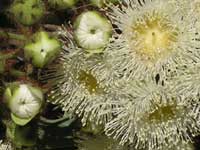
Dwarf Apple image pb180005 174KB
Dwarf Apple
Angophora hispida
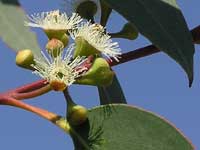
The beauty of this stunning tree is that it is small - only 5 or so metres in height - thus allowing close examination of its incredible buds and flowers.
Angophoras don't have caps on their gumnuts.
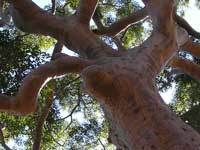
Sydney Red Gum image p9260226 193KB
Sydney Red Gum
Angophora costata
This gangling red giant can be up to 30 metres tall. It is best seen in late summer after it has shed its bark.
Also see the Sulphur-crested Cockatoos web page.
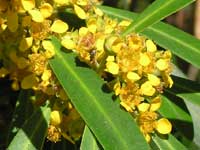
Water Gum p1200397 148KB
Water Gum
Tristaniopsis laurina
This summer flowering medium size tree is found in gullies and next to creeks.
Its botanical name comes from its laurel like leaves
Scribbly Gum image p4210342 97KB
Scribbly Gum
Eucalyptus haemastoma
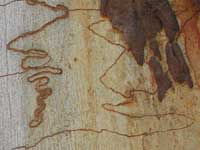
Identified by its signature - see right. It flowers in autumn - compared to the other scribbly gums (E. racemosa and E. sclerophylla) which are spring and summer flowering respectively.
Scribbly Gum image p4210359 141KB
Scribbly Gum
Eucalyptus haemastoma
Scribbly Gums are named after the scribbles on the bark - which are made by the larva of a very small moth.
White Mahogany image pc180059 105KB
White Mahogany
Eucalyptus acmenoides
Distinguished from other stringybarks by its "wine glass" cap and discolorous leaves - leaves darker on one side than the other. It flowers in Spring and Summer and grows to over 30m.
Turpentine image pa100145 119KB
Turpentine
Syncarpia glomulifera
Found along the NSW and Queensland coast and ranges. It can grow to 25 metres. Turpentine piles were used in the wharves of Sydney and London.

Bottlebrush - Callistemon genus
The 30 bottlebrush species are only found in Australia - with 19 in NSW and 9 in the greater Sydney area.
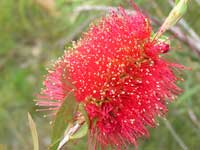
Crimson Bottlebrush image pa210249 127KB
Crimson Bottlebrush
Callistemon citrinus
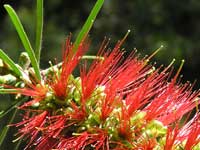
One of the more common bottlebrushes, it flowers in late spring. Its crushed leaves give a distinctive citrusy fragrance.
Narrow-leaved Bottlebrush image pb040350 160KB
Narrow-leaved Bottlebrush
Callistemon linearis
Also flowering in late spring, this bottlebrush is best identified by its narrow (1-3mm) long leaves.

Tea-tree - Leptospermum genus
The Tea-tree was so named because it was used by Captain Cook's
sailors as a tea substitute. The species used was Manuka (Leptospermum scoparium).
Tea-tree oil is actually from Melaleuca alternifolia which is only found in Northern NSW.
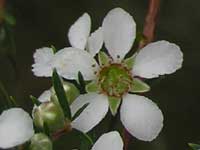
Paperbark Tea-tree image pa200003 106KB
Paperbark Tea-tree
Leptospermum trinervium
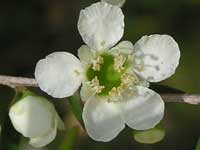
This small tree is the most common tea-tree species in the Park. It is easily identified by its paperbark trunk and woolly buds.
Woolly Tea-tree image pa300122 76KB
Woolly Tea-tree
Leptospermum grandifolium
A shrub to small tree, it is also a common species. It has a smooth trunk and the under-surface of its leaves is woolly.
Also called the Mountain Tea-tree.
Deane's Tea-tree image pa130432 83KB
Deane's Tea-tree
Leptospermum deanei
This is an uncommon species and is classed as vulnerable. It is only found in the Sydney area and is identified by its slender (1-2mm wide) leaves.
Pink Tea-tree image p9130197 70KB
Pink Tea-tree
Leptospermum squarrosum
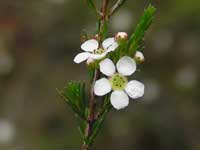
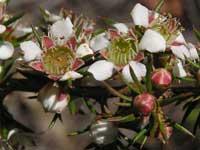
More commonly autumn flowering with pink flowers, this white flowering plant was found in spring. The 20mm wide "pink" flowers and sepals identify it.
It is also called the Peach Blossom Tea-tree.
Prickly Tea-tree image pb120189 106KB
Prickly Tea-tree
Leptospermum juniperinum
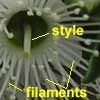
This shrub is easily identified by its prickly leaves - its new growth is not prickly. The leaves and flowers are held very tightly to the branches.
Kunzea genus
Distinguished from the Leptospermum (tea tree) genus by its long
filaments and style - the latter coming from the centre of the flower.
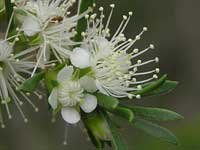
Kunzea flower
Tick Bush image pb070143 87KB
Tick Bush
Kunzea ambigua
Flowering in late spring, the flowers are about 7mm from petal-tip to petal-tip.
It is also called the White Kunzea.
Pink Buttons image p9150118 106KB
Pink Buttons
Kunzea capitata
Flowering in spring, the flower ball has a diameter of about 15mm - but its pink colour identifies it.
It is also called the Heath Kunzea.
Burgan image pb170025 88KB
Burgan
Kunzea ericoides
Similar flower to the White Kunzea, but its 20mm long leaves and the 5mm pedicel (stalk) clearly identifies it. Burgan is a Koori word.

Darwinia genus
The unique shape of the flowers identifies this genus.
Named after Charles Darwin's grandfather - Erasmus Darwin.
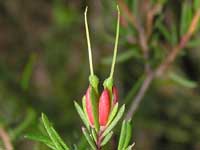
Darwinia biflora image p7150166 87KB
Darwinia biflora
Darwinia biflora
There is no common name for this small inconspicuous plant - I suggest "Twin Darwinia".
It is identified by its pair of green flowers with red bracteoles. The corolla (tube) is 7mm long; the style 10mm.
It is classified as vulnerable and is only found in the northern and north-western suburbs of Sydney.
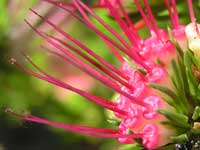
Clustered Darwinia image p9130163 124KB
Clustered Darwinia
Darwinia fascicularis
Identified by the many flowers in each "cluster". They start off white in colour and become red.
Also called the Cluttered Scent Myrtle due to the aroma given off by the leaves.
It flowers in late winter and early spring.
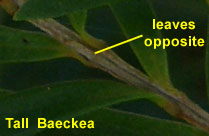
Other genera of the family Myrtaceae

Rosy Baeckea image p9160116 66KB
Rosy Baeckea
Euryomyrtus ramosissima
This tiny flower (4mm wide) looks like a tea-tree flower - and they do both belong to the Myrtaceae Family.
Weeping Baeckea image p1200331 72KB
Weeping Baeckea
Baeckea linifolia
The 5mm wide flowers appear in summer. The shrub is up to 2 metres high and its weeping form distinguishes it.
Common Fringe Myrtle image p7170253 82KB
Common Fringe Myrtle
Calytrix tetragona
This plant is found across the southern states of Australia and into Queensland. The thread coming from the tip of each of the five sepals is known as an awn. The petals are about 5mm in length. Apparently, it is easily grown.
Narrow-leaf Myrtle image pc180126 62KB
Narrow-leaf Myrtle
Babingtonia densifolia
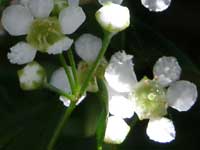
Formerly called Baeckea densifolia, the flowers of this small shrub are about 7mm across. The stem leaves are appressed, while the leaves at the end of the branches are crowded and curved at the tip.
Fringed Baeckea image pc180049 93KB
Fringed Baeckea
Baeckea diosmifolia
This small scrub can be identified by its tiny teeth on the 3mm long leaves. Its flowers are 6mm across, and commonly have 8 stamens.


doteasy.com - free web hosting. Free hosting with no banners.
Doteasy Web Hosting